Finding Overseas Buyers: Why Manufacturers Should Search by Application, Not Just Product Name
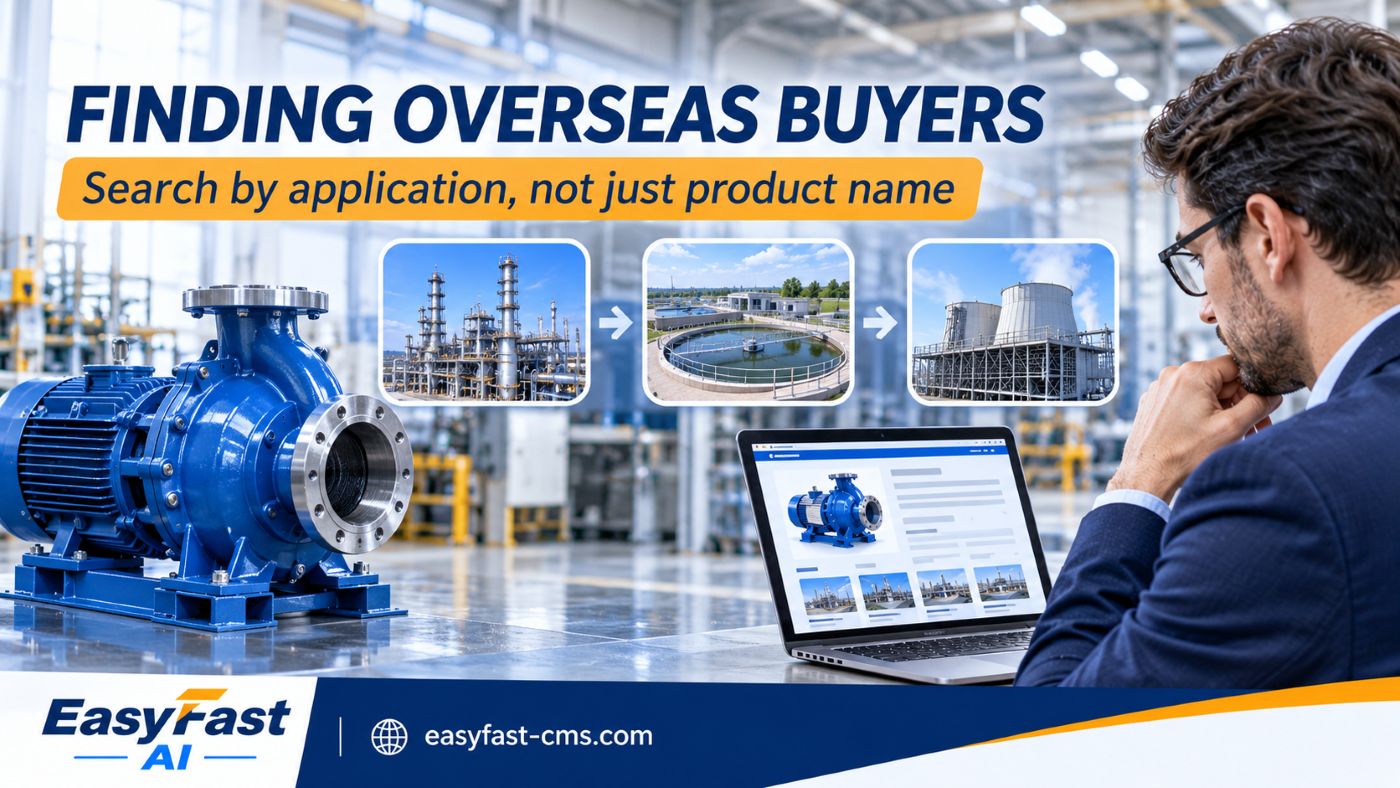
Finding Overseas Buyers: Why Manufacturers Should Search by Application, Not Just Product Name
A manufacturer makes a product and wants to find overseas customers. The first instinct is usually straightforward: search for the product name, find companies that sell or use it, and start contacting them.
This is a reasonable starting point. But it can also limit the search.
A product name tells you what a factory makes. It does not necessarily tell you who needs it, why they need it, or under what conditions they will buy it.
In B2B manufacturing, the application often reveals more about a potential buyer than the product name alone.
The same product can serve very different markets
Consider an industrial pump manufacturer.
A search for “industrial pump importer” may find distributors, trading companies, and general equipment suppliers. Some may be relevant, but the search does not tell you whether their customers need the particular pump the manufacturer can supply.
Now consider the product from the application side.
A pump may be used in:
- Chemical processing, where the pumped medium and material compatibility matter.
- Water and wastewater treatment, where flow rate, head, and operating conditions influence selection.
- Industrial cooling systems, where continuous operation and system requirements matter.
- Mining and mineral processing, where the characteristics of the fluid and working environment can determine equipment suitability.
These are not interchangeable purchasing situations. Each application has different technical requirements, different decision-makers, and potentially different types of buyers.
A company operating a chemical plant, an engineering contractor designing a water treatment facility, and a distributor supplying industrial equipment may all have a reason to evaluate pumps. But they do not necessarily search for them in the same way.
The opportunity is to understand the application before deciding which companies to approach.
Start with the problem the product is used to solve
A useful prospecting process begins with three questions.
First: Where is the product used?
Identify the industries, processes, equipment systems, and operating environments in which the product has a genuine application.
Second: What requirement does it address?
Look beyond general descriptions. Buyers may care about material compatibility, pressure, temperature, dimensions, capacity, performance, installation conditions, or customization. The relevant criteria depend on the product.
Third: Which companies are involved in that application?
The potential buyer may be an end user, an equipment manufacturer, an engineering contractor, a system integrator, or a distributor. These companies have different purchasing roles.
This process turns a broad product category into a more useful set of market segments.
Build a buyer map before building a contact list
Finding company names is not the same as identifying potential customers.
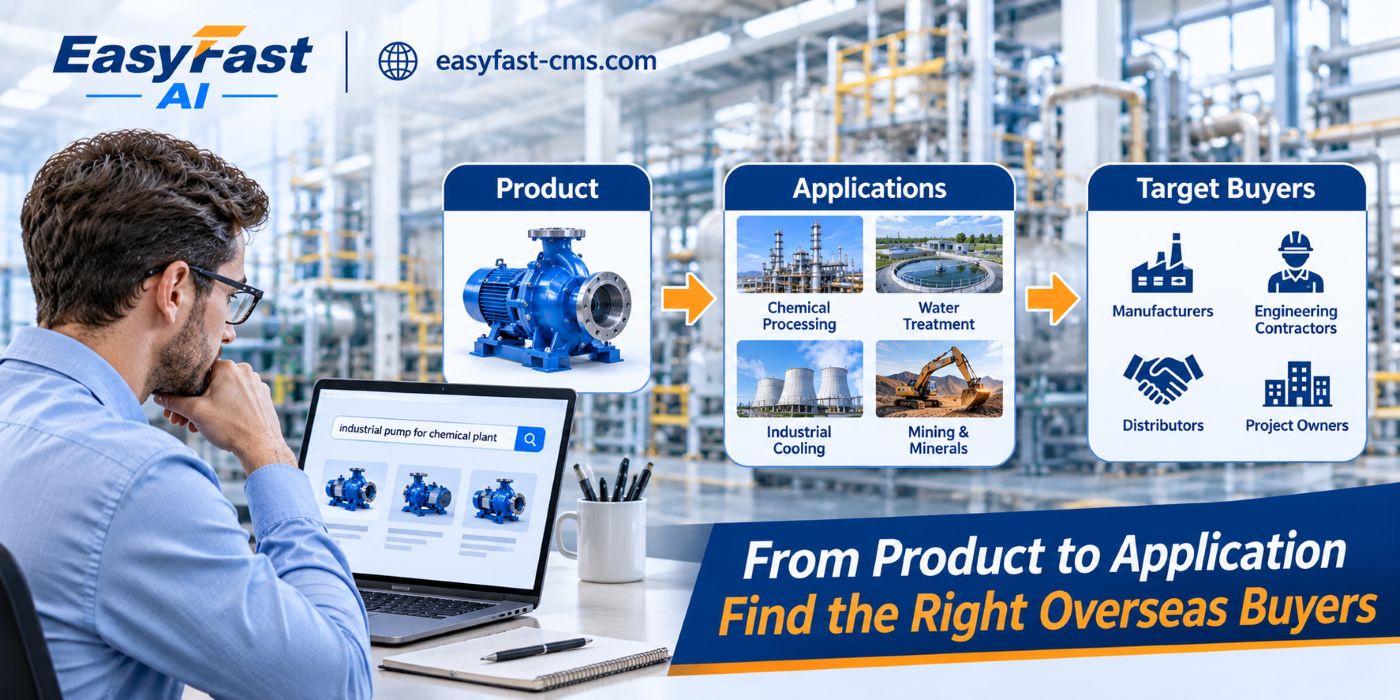
A practical buyer map should connect the product to its applications and then to the companies involved.
For example:
| Research layer | Industrial pump example |
|---|---|
| Product | Industrial centrifugal pump |
| Application | Chemical processing |
| Operating requirements | Fluid properties, material compatibility, flow and head |
| Potential company types | Chemical plants, process engineering contractors, equipment integrators |
| Possible contacts | Procurement, engineering, project management, equipment sourcing |
This is an initial research framework, not proof that every company in those categories is a suitable buyer.
A company should be evaluated against the manufacturer's actual product capabilities. If the factory cannot meet a particular material, pressure, capacity, or certification requirement, that prospect should not be treated as a qualified opportunity simply because the industry looks relevant.
Qualification matters more than collecting names
Once a list of companies has been identified, the next step is to check whether there is a real match.
Useful questions include:
- Does the company operate in an industry relevant to the product?
- Does it manufacture, install, distribute, or purchase this type of equipment?
- Does its website or public material show relevant products, projects, or applications?
- Does the manufacturer have the technical capability and documentation required by this market?
- Is there a relevant purchasing, engineering, or project contact?
The answers will not always be available from public information. Some details require direct communication.
That is why prospect research should distinguish between a company that looks relevant and a company whose purchasing need has been confirmed.
A well-organized prospect list should preserve the evidence behind each assessment, rather than treating every search result as a sales lead.
Turn product knowledge into a repeatable prospecting method
Manufacturers often already possess much of the information needed for this research: product specifications, application descriptions, technical documents, customer cases, and industry experience.
The challenge is that this knowledge may not be organized in a way that supports systematic market research.
When product information is structured around applications, it becomes easier to identify:
- The industries that may use the product.
- The operating conditions that define a suitable application.
- The types of companies involved in purchasing or specifying it.
- The search terms buyers may use when describing their requirements.
- The technical questions that salespeople need to ask before qualifying an opportunity.
This also creates a useful connection between the company's website and its sales process. Product pages explain what the factory makes. Application pages explain where and why the product is used. Case studies provide relevant project context where genuine evidence is available. Sales teams can then use the same information when researching and communicating with potential buyers.
EASYFAST AI supports this approach by organizing company and product knowledge and connecting website content with prospect discovery and customer follow-up workflows. Prospect information can be researched and assessed against a company's target profile, while AI-assisted outreach drafts can be prepared using prospect context and enterprise knowledge. Human review remains important before outreach is sent.
The objective is not to contact the largest possible number of companies. It is to develop a clearer understanding of which companies have a plausible reason to consider the manufacturer's products.
A better search begins with a better question
Instead of asking only, “Who imports this product?”, manufacturers can ask:
“Which companies operate the processes where this product is needed?”
That change does not guarantee a sale, and it does not eliminate the need for technical evaluation or direct qualification. But it gives prospect research a more meaningful starting point.
A product name helps you find a market category. An application helps you understand the demand within that market.
For manufacturers looking for overseas customers, that distinction can make the difference between collecting a long list of company names and building a focused pipeline of potential buyers.