AI Is Changing How Manufacturing Buyers Find Suppliers: Is Your Product Information Ready?
AI Search Is Exposing a Problem Many Manufacturers Have Ignored: Their Product Knowledge Is Hard to Understand
A manufacturer may have spent twenty years developing industrial products, refining production processes and serving demanding customers. Its engineers know exactly which materials are suitable for different operating conditions. Its sales team understands the differences between product configurations. Its technical department can explain why one model is appropriate for a particular application while another is not.
Yet when an overseas buyer visits the company's website, much of that knowledge may be nowhere to be found.
The website might show a product name, a photograph, a short description and a contact form. The detailed specifications are stored in a PDF. Application information is buried in an old catalogue. Important technical explanations exist only in the minds of experienced employees.
This was already a problem for traditional search visibility. AI-assisted search makes the gap harder to ignore.
A product name is not a product explanation
Consider a manufacturer producing industrial centrifugal pumps.
A product page might say:
"Industrial Centrifugal Pump — High Efficiency, Reliable Performance."
This description tells a visitor very little. It does not explain the pump's operating conditions, available materials, flow range, pressure range, installation requirements or intended applications.
A buyer evaluating the product may need answers to much more specific questions:
- Is this pump suitable for a corrosive liquid?
- What materials are available for the wetted components?
- What flow rate and head can the selected configuration support?
- Can the manufacturer customize the pump for a particular application?
- What technical documents are available for evaluation?
These are not simply additional keywords to insert into a page. They are questions that determine whether a product deserves further consideration.
If the manufacturer has the answers but does not make them accessible, the website presents an incomplete picture of the company's actual capabilities.

The information problem starts inside the factory
In many manufacturing businesses, product knowledge is distributed across departments and file formats.
Engineering maintains drawings and technical specifications. Production understands manufacturing constraints. Quality teams hold inspection records and certificates. Sales teams collect customer questions and application requirements.
Each department may have accurate information, but the information is not necessarily organized for someone outside the company.
This creates several practical problems.
A product catalogue may describe a standard configuration, while a separate quotation sheet contains a different specification. An old product page may remain online after a product has been updated. A salesperson may know an important application limitation that is absent from the public website.
For a human buyer, some of these gaps can be resolved through emails and conversations. For a search system trying to understand a company from its published information, the gaps are much harder to resolve.
The issue is not that every manufacturer needs to publish every internal document. It is that the information intended for buyers must be consistent, specific and understandable.
What makes product information useful to a buyer?
The answer depends on the product and the purchasing decision. A complex industrial component needs a different level of explanation from a simple standard item.
For a technical product, a useful information structure often needs to cover several connected dimensions.
Product identity and configuration
What exactly is being offered? What models, versions, configurations or options are available? Which characteristics distinguish one model from another?
Technical operating conditions
What are the relevant performance parameters? Under what conditions do the stated specifications apply? Are there limitations that a buyer should understand before selecting a model?
Materials and manufacturing capabilities
What materials and manufacturing processes are available? Which customization requests can the factory support? Which requirements need technical confirmation?
Applications and selection guidance
Where is the product used? What operating conditions or industry requirements influence product selection? What information should a buyer provide when requesting a quotation?
Supporting documentation
Are there product drawings, manuals, technical data sheets, inspection documents or relevant certifications that can support the evaluation? Only documents that actually exist and are authorized for publication should be presented.
These elements should not become five disconnected sections added simply to make a page longer. They should explain one product from the perspective of how it is selected, specified and used.
One product should not become five inconsistent descriptions
A common content problem appears when the same product is described separately across a website, catalogue, application page, FAQ and sales email.
The product name may change slightly. Technical values may be copied from different versions of a document. One page may describe a capability that another page does not mention. Translations may introduce terminology that the engineering team would never use.
This is not just an editorial inconvenience. It creates uncertainty for buyers and makes the company's information harder to maintain.
A more reliable approach is to establish an authoritative product information source first.
The product page, application explanations, frequently asked questions, technical downloads and related articles can then draw on the same verified information. Each page serves a different purpose, but the underlying product facts remain consistent.
This is also where a company's internal knowledge becomes valuable beyond its own employees.
The role of an enterprise knowledge base
An enterprise knowledge base should not be treated as a folder where documents are uploaded and forgotten.
Its purpose is to organize company information so that people and AI-assisted workflows can use it consistently.
For a manufacturer, that may include company background, product documentation, technical terminology, manufacturing capabilities, application information and approved brand language.
When content is generated, this knowledge provides the reference material. It does not remove the need for engineering verification or human review. If the source material does not support a technical claim, the claim should not be invented to make the page sound more complete.
This distinction matters.
AI can help organize information, draft explanations, create language versions and connect related content. It cannot independently confirm that an undocumented pressure rating is correct or that a factory can manufacture a configuration it has never produced.
The quality of the output remains dependent on the quality and accuracy of the source information.
This is where website architecture becomes important
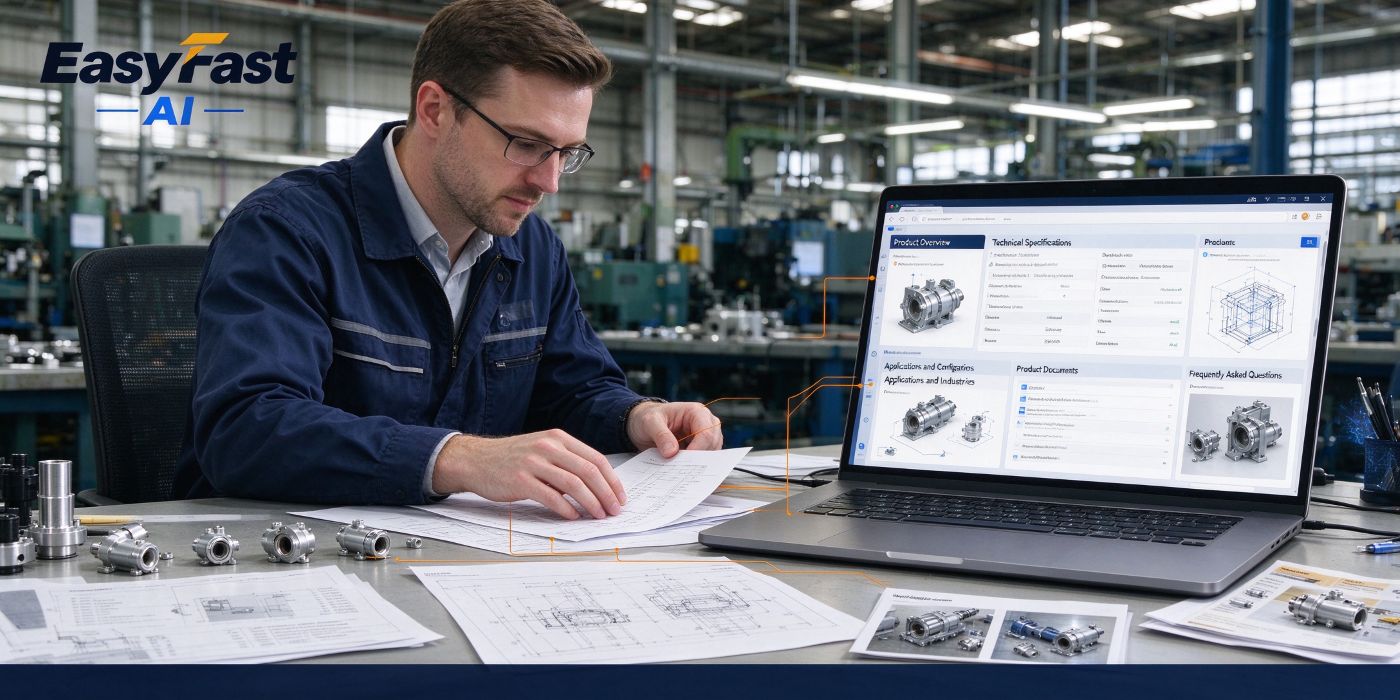
A well-organized manufacturing website should make the relationship between products and their supporting information clear.
A product may connect to its technical specifications, applications, relevant case studies, FAQs, downloads and explanatory articles. These pages should not exist as isolated content created merely to increase the total page count.
They should answer different questions that arise during the same purchasing journey.
For example, a buyer who discovers an industrial pump through a product page may next need to understand its application in water treatment. The application page can explain the operating context. A technical document can provide detailed specifications. An FAQ can address a recurring selection question.
The links between these pages help visitors navigate the information. They also provide search engines with a clearer view of how the company's products, capabilities and expertise are related.
For manufacturers with multiple products and markets, maintaining these relationships manually can become difficult. A structured content system can make the information easier to manage and reuse.
What EASYFAST AI is designed to address
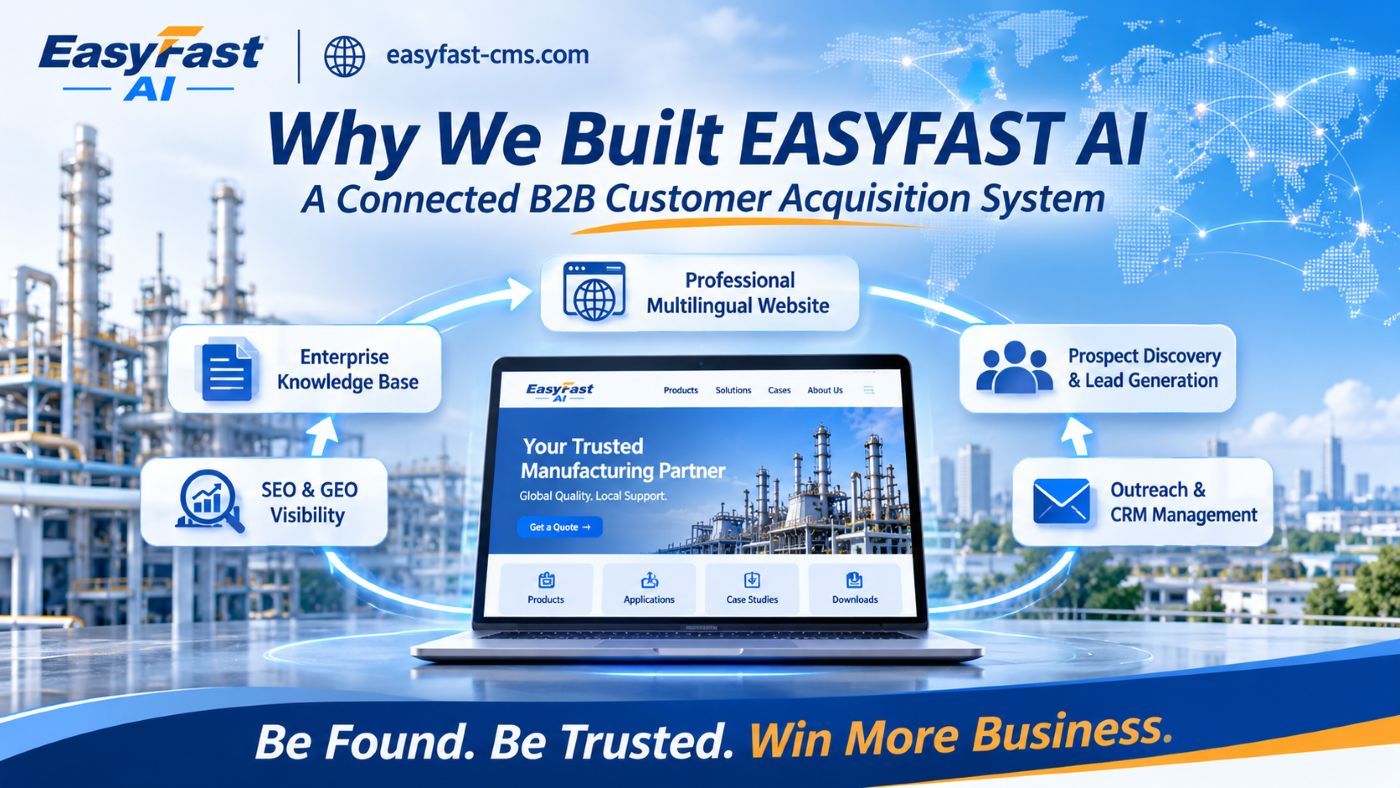
EASYFAST AI approaches this problem from the perspective of the entire business website rather than treating every product page or article as a separate writing task.
Its enterprise knowledge base provides a shared information source for AI-assisted content production. Its content pipeline supports topic selection, material preparation, generation, polishing, metadata creation and compliance checking, with human review retained before publication.
The system can also extend information around a real product into related application pages, case studies, FAQs, articles, downloads and internal links.
This does not guarantee that a product will appear in an AI-generated answer or that a website will achieve a particular search ranking. It provides a more organized way to manage the information that search systems and potential buyers may encounter.
For a manufacturer, the starting point is not producing more pages. It is making sure that the information behind those pages is accurate, connected and useful.
A factory's expertise is built over years. Its website should not reduce that expertise to a product name and a generic paragraph.