Why Are So Many B2B Leads a Waste of Time for Manufacturers?

Why Are So Many B2B Leads a Waste of Time for Manufacturers?
A manufacturer finds 300 companies through Google. The list includes company names, websites, email addresses and phone numbers. The sales team starts sending introductions.
A few days later, the replies begin to come in. Some companies say they do not handle the product. Some are not interested. Some never respond. A few addresses bounce. After weeks of work, the team may have only two or three conversations worth pursuing.
This is not unusual in overseas B2B sales.
The problem is often blamed on the email, the subject line or the timing. Those things matter, but sometimes the mistake happened much earlier: the companies on the list were never suitable prospects in the first place.
Finding an email address is relatively easy. Finding a company with a genuine reason to buy from your factory is a different job.
A company in the right industry may still be the wrong prospect
Imagine a Chinese factory producing industrial valves and looking for customers in the Middle East.
A search for oil and gas companies might produce a long list of results. At first glance, it looks promising. But take a closer look.
One company operates oil fields. Another provides engineering services. A third is an equipment distributor. A fourth is a general trading company. They all have some connection to the oil and gas sector, but their purchasing needs are not the same.
The oil field operator may purchase valves for its own facilities, but supplier approval could involve technical specifications, project references and a lengthy qualification process.
The engineering company may influence product selection without purchasing the equipment itself.
The distributor may already have established suppliers, but could be interested in adding another manufacturer to its portfolio.
The trading company may be relevant, or it may simply list a wide range of unrelated products on its website.
If the factory sends the same sales message to all four, it is treating four different business situations as if they were identical.
That is how a large prospect list becomes a source of wasted effort.
Before searching, decide who you actually want to sell to
Many manufacturers begin prospecting with a product name or a broad industry keyword. It is a convenient starting point, but rarely enough.
Take a pump manufacturer as an example. Its potential overseas customers might include pump distributors, water treatment contractors, agricultural irrigation companies, industrial equipment suppliers and project engineering firms.
These businesses may all purchase pumps, but they buy for different reasons.
A distributor may care about product range, pricing, stock availability and whether the manufacturer can support repeat orders. A contractor may be more concerned about project specifications, delivery schedules and technical documentation. An industrial end user may need a pump that meets a particular operating requirement.
The manufacturer should decide which type of customer it wants to approach before building a list.
This decision also affects where to search. Distributor directories, project announcements, industry exhibitions and company websites reveal different kinds of prospects. Searching only by a generic product keyword can miss the companies that matter most.
There is no universal list of the best buyer types. The right target depends on the product, the manufacturer's capabilities, its export experience and the markets it can serve.
The company's website often tells you more than its email address
When reviewing a potential customer, do not start by copying the contact details.
Spend a few minutes understanding what the company actually does.
Look at its product categories. Does it already sell products similar to yours? Does it serve the same industries? Does it represent several established brands? Does it have a technical or project-related business rather than simply trading general merchandise?
Its customer base can also provide clues. A distributor serving water treatment companies may be relevant to a pump manufacturer. A supplier focused on household plumbing products may not be a good match for an industrial pump range.
Pay attention to the language used on the website. Terms such as authorized distributor, stockist, project supplier, system integrator and manufacturer's representative can reveal the company's business role.
None of these details guarantees that the company is looking for a new supplier. They help answer a more basic question: is there a reasonable business connection worth exploring?
A short review before sending an email can prevent a much longer waste of time afterward.
Do not confuse a contact person with a purchasing decision-maker
Another common problem appears after a suitable company has been found.
The sales team obtains an email address and assumes the research is complete. But the person behind that address may have little involvement in supplier selection.
For a small distributor, the owner or managing director may handle purchasing directly. At a larger industrial company, supplier decisions may involve procurement, engineering, project management and senior management.
The right contact also depends on what you are selling.
If the product requires technical evaluation, an engineering or technical manager may be an important person to reach. If the company is a distributor, the purchasing manager or product manager may be more relevant. For a small trading business, the owner could be the most practical starting point.
Sometimes the first contact is simply the person who can direct you to the right department. That is still useful, provided the sales team understands the distinction.
A database containing 500 general email addresses may look more complete than one containing 100 researched contacts. But the second list can be far more useful when each contact has a clear reason for being there.
A prospect list should change when the market gives you feedback
There is another mistake manufacturers make: they keep using the same search criteria even when the results are poor.
Suppose a factory contacts 100 companies described as industrial distributors. Most do not respond, and several explain that they do not handle the relevant product category.
The next step should not automatically be to find another 500 distributors.
Review the companies that did respond. What products do they sell? Which industries do they serve? Are they importers, local stockists or project suppliers? What countries do they operate in? Were the contacts responsible for purchasing?
The answers may show that the original target was too broad.
Perhaps the more relevant prospects are specialist distributors rather than general industrial suppliers. Perhaps the product is better suited to engineering contractors. Perhaps a particular market has stronger demand for the manufacturer's specifications.
This is how sales feedback should influence prospect research.
A rejected prospect is not necessarily useless information. If several companies give the same reason for declining, that pattern may reveal a weakness in the targeting strategy.
The sales team should record these reasons rather than simply marking every unsuccessful contact as "no reply".
More leads are not always the answer
There is pressure on sales teams to show activity. More companies found, more emails sent and more contacts added to the CRM can make the work look productive.
But these numbers do not explain whether the team is reaching the right market.
Consider two situations.
In the first, a salesperson contacts 200 companies with little research. The list is large, but many companies have no clear connection to the product.
In the second, the salesperson researches 40 companies, identifies their business roles and approaches contacts whose responsibilities are relevant.
The second approach does not guarantee more orders. It does, however, give the salesperson a clearer basis for starting a business conversation and learning from the response.
For a small manufacturing sales team, that distinction matters. Time spent investigating unsuitable companies is time not spent developing relationships with relevant buyers.
The aim is not to make the prospect list look impressive. It is to make the next sales action more worthwhile.
Making prospect research part of the sales process
This is also where tools can make a practical difference.
When company discovery, website research, contact identification, email outreach and follow-up are handled in separate spreadsheets or platforms, useful information can easily be lost. A salesperson may contact a company without knowing that another colleague has already approached it. The reason a prospect was selected may never be recorded. Responses may not feed back into future searches.
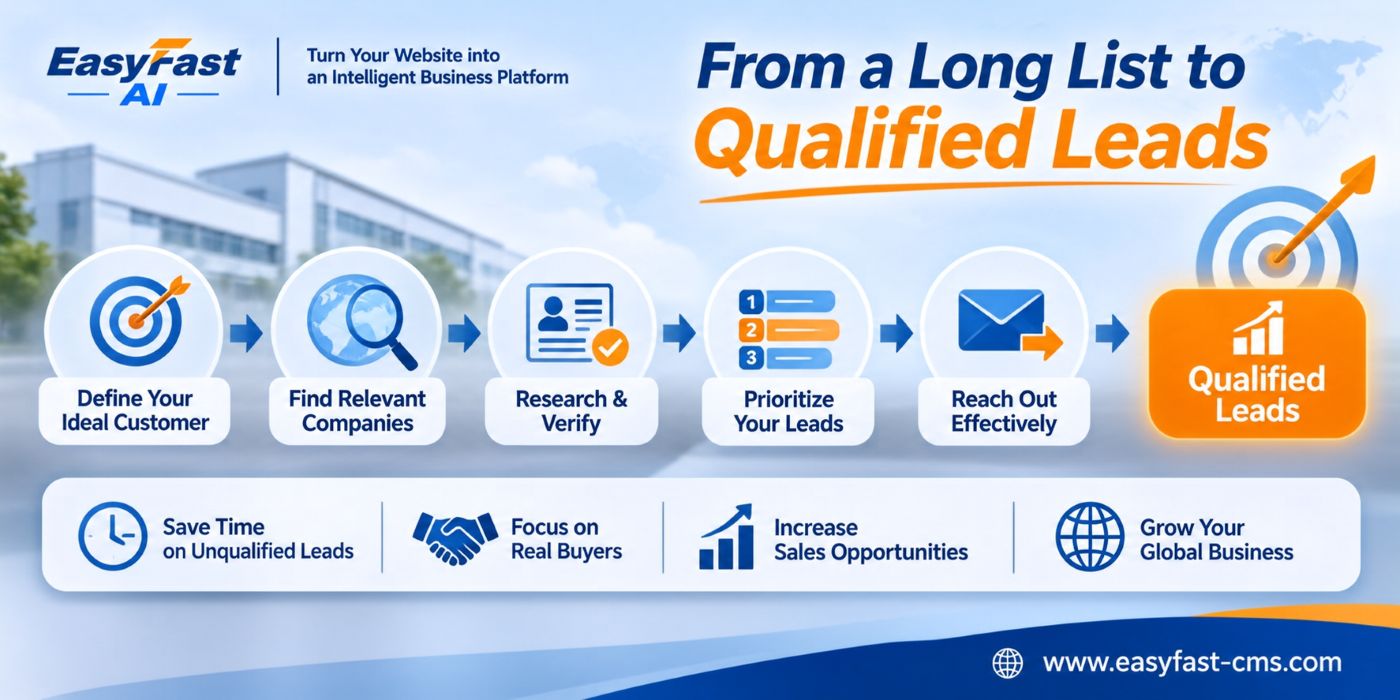
EASYFAST AI brings prospect discovery, company and contact research, lead evaluation, outreach support and CRM follow-up into a connected B2B customer acquisition workflow.
The purpose is not to generate the largest possible list or send more messages automatically. It is to help manufacturers organize the work behind finding and developing overseas prospects.
The quality of the results still depends on the accuracy of the product information, the targeting criteria, the available company data and the judgment of the sales team.
The real work starts before the first email
When an overseas prospect does not reply, it is tempting to focus immediately on rewriting the email.
But it is worth going back one step.
Did the company actually need the product? Was it the type of buyer the factory wanted? Did the salesperson understand its business? Was the right person contacted?
If those questions cannot be answered, sending another message may not solve the problem.
Manufacturers do not need an endless supply of company names. They need a reliable way to identify businesses that have a plausible reason to work with them.
That work begins long before the first sales email is sent.