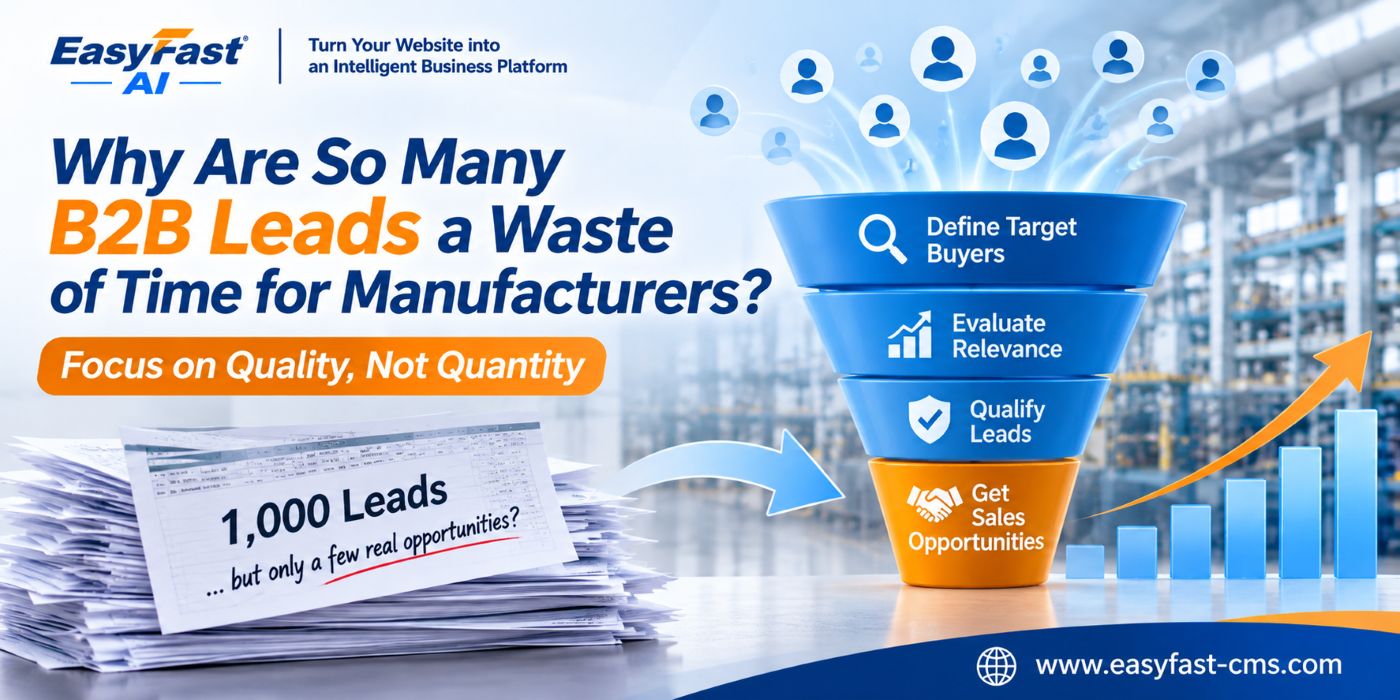
Why a Long List of Prospects Doesn't Mean You Have More Sales Opportunities
Why a Long List of Prospects Doesn't Mean You Have More Sales Opportunities
For many manufacturing exporters, finding potential overseas customers seems straightforward at first. Search for companies in the target market, collect their website addresses, find email contacts, and start sending introductions.
The result can look impressive: hundreds or even thousands of company records in a spreadsheet.
But after several weeks of outreach, the response may be disappointing. Many companies are not relevant to the products being offered. Some contacts have nothing to do with purchasing. Others have outdated email addresses, and some companies may already have established suppliers.
This raises an important question: Are you building a list of companies, or are you identifying genuine sales opportunities?
A Prospect Is Not Automatically a Potential Buyer
A company operating in the same industry is not necessarily a suitable customer.
Consider a manufacturer exporting industrial valves. A broad search for companies related to industrial equipment may return manufacturers, distributors, engineering contractors, maintenance providers, and end users.
All of them may be relevant to the wider industry, but their purchasing needs are different.
- A distributor may be looking for products to add to its portfolio.
- An engineering contractor may purchase equipment for specific projects.
- An end user may need replacement products or equipment for an existing facility.
- Another manufacturer may be a competitor rather than a buyer.
Sending the same introduction to all these companies ignores the differences that matter most in B2B sales.
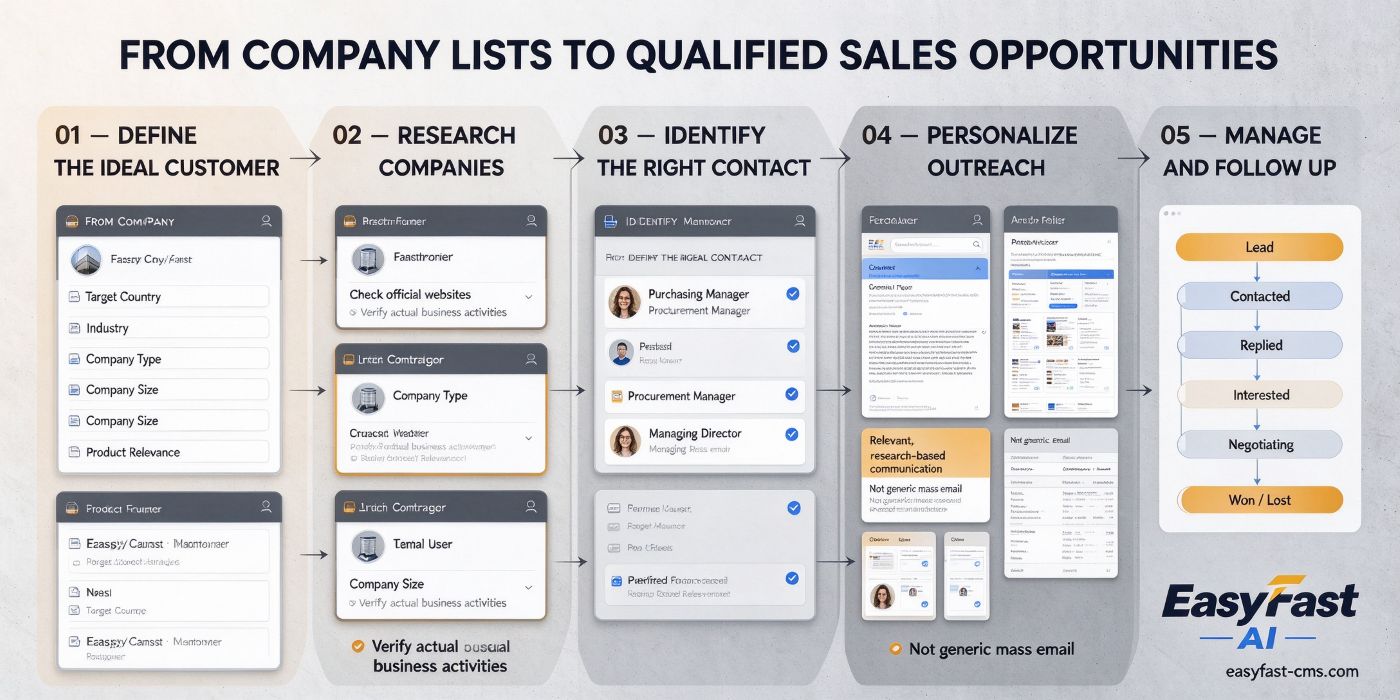
Before collecting contact details, define what a suitable prospect looks like. Start with the target country, industry, company type, business size, product relevance, and the role of the person you want to reach.
The more clearly these conditions are defined, the less time the sales team will spend reviewing irrelevant records.
Start With the Product, Not Just an Industry Keyword
One common mistake in prospect research is relying on a single broad keyword.
For example, searching for industrial equipment may produce a large number of results, but the term is too general to describe a specific purchasing need.
A more useful approach is to work backwards from the product:
- Define the product. Identify the actual product category, specifications, materials, and applications.
- Identify where it is used. Consider the industries, facilities, and processes that require the product.
- Identify who purchases it. Determine whether the likely buyer is a distributor, contractor, OEM, importer, or end user.
- Translate the profile into search criteria. Combine product-related terms with application, company type, and target-market information.
For example, instead of searching only for industrial valves, a supplier might investigate water treatment equipment distributors, pipeline engineering contractors, and industrial maintenance companies in selected markets.
These are different prospect groups. Each requires its own qualification criteria and outreach message.
Company Research Should Come Before Contact Discovery
Finding an email address is not the same as understanding a company.
Before approaching a prospect, review its official website and available business information. Look for evidence that the company actually operates in a relevant market.
Useful questions include:
- What products or services does the company currently offer?
- Does it manufacture, distribute, import, or install equipment?
- Does its business model match the type of customer you are targeting?
- Does it serve the industries where your products are used?
- Is there any indication that your product could complement its existing business?
This research does not need to become a lengthy report for every company. Even a short review can help distinguish a relevant prospect from a company that merely shares a keyword.
It also gives the salesperson something meaningful to refer to when writing the first email.
Verify the Contact Before Sending the First Email
Once a company has passed the initial review, the next task is to identify an appropriate contact.
In manufacturing and industrial supply, the relevant person may have a title such as Purchasing Manager, Procurement Manager, Sourcing Manager, Managing Director, or Business Development Manager. The appropriate role depends on the company's size and structure.
A small distributor may have its owner handling purchasing decisions. A larger industrial group may have a dedicated procurement department.
Contact discovery should therefore be based on the company's structure rather than on job titles alone.
Email verification is another important step. Invalid addresses can lead to bounced messages and create unnecessary risks for the sender's domain reputation. Verification does not guarantee delivery, but it helps identify addresses that should be reviewed or excluded before an outreach campaign.
Companies should also respect applicable privacy and electronic marketing requirements in the markets they contact. Use relevant business contact information responsibly, identify the sender clearly, and provide a practical way for recipients to opt out where required.
Personalization Should Be Based on Research, Not Just a Name
Many sales emails are described as personalized simply because they include the recipient's name and company name.
That is not enough.
A useful first message should show why the sender chose to contact that particular company.
For example, compare these two approaches:
Generic introduction:
Dear John, We are a professional manufacturer of industrial products. We offer high-quality products at competitive prices. Please let us know if you have any requirements.
Research-based introduction:
Dear John, I noticed that your company supplies equipment for water treatment projects. We manufacture industrial valve products used in related applications, and I thought there might be a potential fit with your product range. Would you be the right person to speak with about supplier opportunities?
The second message is more relevant because it connects the supplier's offering with something observable about the prospect's business.
However, personalization must remain factual. Do not claim that a company has a specific project, purchasing requirement, or technical problem unless that information has been verified.
One Email Is Only One Step in a Longer Sales Process
In B2B manufacturing, purchasing decisions often involve several people, technical evaluations, supplier comparisons, and internal approval. A prospect may not respond to the first message even when the product is relevant.
This is why a structured follow-up process matters.
A practical outreach sequence might look like this:
- Initial introduction: Explain briefly why the company was selected and how the product may be relevant.
- First follow-up: Revisit the original message with one additional useful point rather than repeating the same sales pitch.
- Supporting information: Share a relevant product catalogue, technical document, application example, or other material when appropriate.
- Final follow-up: Ask whether the topic is relevant to the recipient and respect their decision if they are not interested.
The timing and number of messages should depend on the market, the recipient's response, and applicable email rules. A sequence should never become an excuse for repeatedly contacting someone who has declined further communication.
Keep Every Prospect's History in One Place
As the number of prospects increases, spreadsheets and individual mailboxes become difficult to manage.
A salesperson may remember contacting a company but forget which product was discussed. Another team member may approach the same prospect without knowing that a previous conversation already took place.
A practical prospect management process should record at least:
- Company name, website, country, and industry.
- Contact name, role, and business email address.
- Where the prospect information came from.
- Verification status and qualification notes.
- Outreach history and replies.
- Current sales stage and the next follow-up action.
A clear pipeline also helps the team distinguish between a newly discovered lead and a genuine opportunity. For example, a contact may move through stages such as Lead, Contacted, Replied, Interested, Negotiating, Won, or Lost.
These stages make it easier to understand where opportunities are progressing and where the sales process is getting stuck.
Measure the Quality of the Process, Not Just the Number of Records
A large prospect database may look productive, but record volume alone says very little about sales performance.
It is more useful to review the process at several levels:
- Research quality: How many discovered companies actually match the target customer profile?
- Contact quality: How many records contain relevant, usable business contacts?
- Outreach quality: Are messages reaching the right people and generating meaningful replies?
- Sales progress: How many conversations move into product discussions, quotation requests, or negotiations?
These measures help identify the real bottleneck. If most companies are irrelevant, improve the search criteria. If contacts are incorrect, improve contact research. If relevant prospects receive messages but rarely respond, review the value proposition and the quality of the outreach.
Do not assume that increasing the number of emails sent will solve every problem.
Turning Prospect Research Into a Repeatable B2B Process
For a small export team, the challenge is not simply finding more companies. It is managing the entire process without allowing research, contact verification, email writing, and follow-up to become disconnected activities.
This is where an integrated workflow can help.
EASYFAST AI brings several parts of this process together. Its lead discovery function supports searches based on keywords and filters such as country, industry, language, company size, and target job title. Results can be reviewed before being imported into the prospect database, where company information and quality scores help sales teams prioritize their work.
Contact discovery and email verification support the preparation stage. Outreach sequences help organize multi-step communication, while AI can assist with drafting messages based on prospect information and the company's own knowledge base. Sending remains subject to configured limits and approval controls.
Replies and customer records can then be managed through the CRM pipeline, with stages, notes, activity history, and follow-up reminders.
The objective is not to generate the largest possible list or send the greatest number of emails. It is to help a business move from scattered prospect research to a process that can be reviewed, improved, and managed over time.
Better Prospecting Begins With Better Decisions
A list of 1,000 companies may contain only a small number of businesses that are genuinely suitable for your products. A smaller, carefully researched list can give a sales team a clearer starting point.
For manufacturers entering overseas markets, effective B2B lead generation is not about collecting as many email addresses as possible. It is about understanding who might need the product, identifying the right people, communicating with a relevant reason, and following up professionally.
More data creates possibilities. Better qualification creates more useful sales conversations.
That is the difference between building a contact list and building a B2B customer acquisition process.