Why a Multilingual Website Needs More Than Translation
Adding multiple languages to a manufacturing website may seem straightforward. Translate the original content, place a language switcher in the navigation, and allow overseas visitors to choose their preferred language.
But there is an important difference between a website that visitors can read in several languages and a website that search engines can correctly understand as a multilingual website.
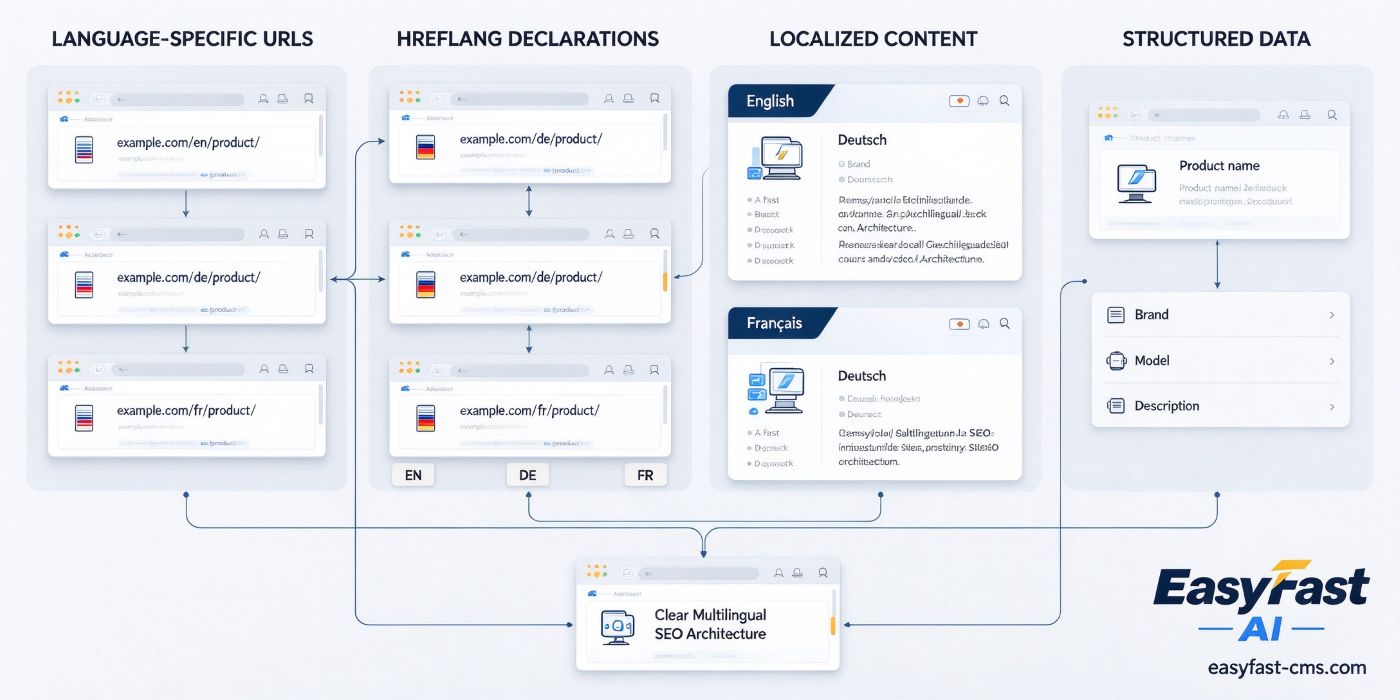
Translation is only one part of the process. URL structure, language declarations, localized page content, and technical signals all influence how different language versions are organized and discovered.
Translation Does Not Automatically Create a Multilingual SEO Structure
Some websites use browser-based or translation plugins to display translated text when visitors select another language. This can make basic content more accessible, but it does not necessarily create independently accessible and indexable language pages.
For example, if a visitor opens a product page in English and a translation tool simply changes the visible text without providing a distinct, crawlable language URL, search engines may have difficulty identifying that English version as a separate page.
A multilingual SEO structure should make each important language version accessible through a stable URL. Search engines need to be able to discover and crawl those URLs independently.
URL Structure: Give Every Language Version a Clear Address
There are several ways to organize multilingual URLs. Common approaches include language subdirectories, language subdomains, and separate country or language domains.
| Structure | Example | Consideration |
|---|---|---|
| Subdirectory | example.com/de/product/ | Languages can be managed under one domain and website structure. |
| Subdomain | de.example.com | Each language can be organized separately, but management may become more complex. |
| Separate domain | example.de | Can support country-specific strategies, but requires additional domain and site management. |
For many small and medium-sized manufacturers, language subdirectories offer a practical way to maintain several language versions within one website.
The important point is consistency. Each language version should have a predictable URL structure, and the relationship between corresponding pages should be clear.
Hreflang Helps Search Engines Understand Language Alternatives
When a product page is available in English, German, French, and Spanish, search engines need signals that identify the intended language or regional audience of each version.
The hreflang attribute can help communicate these relationships. It tells search engines that several URLs are alternative versions of a page for different languages or regions.
For example, a page might use the following declarations:
<link rel="alternate" hreflang="en"
href="https://example.com/en/industrial-valve/" />

<link rel="alternate" hreflang="de"
href="https://example.com/de/industrieventil/" />

<link rel="alternate" hreflang="fr"
href="https://example.com/fr/vanne-industrielle/" />

<link rel="alternate" hreflang="x-default"
href="https://example.com/industrial-valve/" />
These declarations should be implemented consistently across the corresponding language pages. The URLs should be accessible, and the language alternatives should reference one another correctly.
Hreflang is not a ranking guarantee. It is a technical signal that helps search engines understand which language or regional version may be relevant to a user.
Direct Translation Is Not the Same as Localized Content
Even when a website has correctly configured language URLs, translating every sentence word for word may not produce useful content for overseas buyers.
Consider an industrial pump manufacturer.
A Chinese product page may focus on the product model, basic specifications, and general performance. A buyer in another market may search using different technical terminology or want to understand operating conditions, installation requirements, industry applications, and compatibility with existing equipment.
The underlying product facts should remain accurate, but the explanations can be adapted to the terminology and information needs of the target market.
Manufacturers should pay attention to:
- Technical terms commonly used in the target market.
- Local search phrases used to describe the product and its applications.
- Measurement units and specification presentation.
- Industry-specific questions and operating conditions.
- Relevant technical documents and supporting information.
Localization should improve clarity without changing product specifications, certifications, performance claims, or other verified facts.
Structured Data Adds Another Layer of Information
Structured data provides machine-readable information about the content of a page. Depending on the page type, manufacturers may use relevant schema.org vocabulary to describe products, organizations, articles, and other entities.
For example, product structured data can describe information such as product name, brand, model, and other supported product details. Organization structured data can identify the company and its official website.
On a multilingual website, structured data should be consistent with the visible content of each language page. Product names, descriptions, URLs, and language-specific information should not contradict what visitors can actually see.
Structured data does not guarantee enhanced search results or higher rankings. Its purpose is to provide search engines with more explicit information about page content.
A Practical Multilingual SEO Checklist
Before publishing a new language version of a manufacturing website, review the following technical and content elements.
| Check | What to verify |
|---|---|
| Language URL | Each important language page has a stable, accessible URL. |
| Language declaration | The page declares its language correctly. |
| Hreflang | Corresponding language versions reference one another correctly. |
| Canonical URL | Canonical signals are consistent with the intended page version. |
| Localized metadata | Each language page has suitable titles and descriptions. |
| Structured data | Markup reflects the actual content and language of the page. |
| Internal links | Navigation and contextual links lead to the appropriate language pages. |
Multilingual SEO Starts with Website Architecture
A multilingual website should not be treated as one website with several translated text layers. It is a connected structure of language-specific pages, each with its own content, URL, metadata, and technical signals.
For manufacturing companies entering overseas markets, this distinction matters. Buyers need product information in a language they understand, while search engines need a clear structure to discover and interpret the available versions.
Translation makes information readable. A well-organized multilingual website makes that information accessible, identifiable, and easier to maintain.


