When an Overseas Buyer Stops Responding: What Should a Manufacturer Do Next?
You've exchanged several emails with an overseas buyer. They asked about your product, requested a quotation, or discussed a possible application. Then, without explanation, the replies stop.
For manufacturers working with international customers, this situation is familiar. It is also one of the easiest moments to handle poorly. Sending repeated messages without understanding the buyer's situation can make communication less useful rather than bringing the discussion forward.
A lack of response does not necessarily mean the buyer has lost interest. It may indicate that the project has been delayed, internal approval is still pending, another supplier is being evaluated, or the information provided was not sufficient for the next decision.
The practical question is not simply how many times to follow up. It is what the next message should contribute.
Start by Looking at the Last Meaningful Interaction
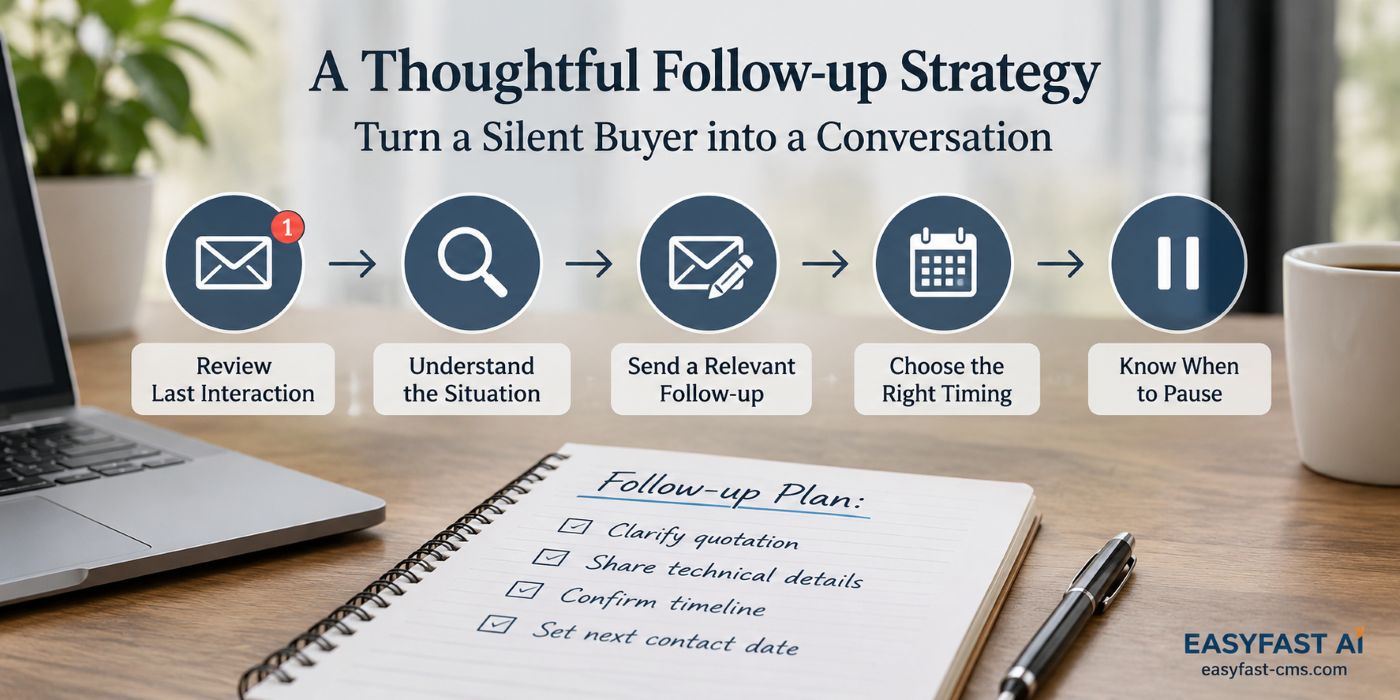
Before sending another email, review the conversation and identify the last point at which the buyer showed clear interest.
Different interactions suggest different next steps:
- After an initial inquiry: The buyer may still be comparing suppliers or collecting basic product information.
- After receiving a quotation: They may need time to review the price, compare specifications, or obtain internal approval.
- After discussing technical requirements: They may be waiting for feedback from an engineer, project manager, or end customer.
- After requesting samples or documents: The next decision may depend on testing, evaluation, or a procurement process.
- After discussing delivery or payment terms: Commercial conditions may still need to be agreed internally.
This review helps you avoid sending a generic reminder when the buyer actually needs a specific answer or supporting document.
Make Each Follow-up Relevant to the Buyer's Situation
A follow-up should give the buyer a reason to continue the conversation. Repeating the original email or asking whether they have seen your previous message rarely adds much value.
Instead, use the information already available in the discussion.
1. If the buyer received a quotation
Rather than asking only whether they have reviewed the quotation, offer to clarify a particular part of it. You might ask whether the selected specification matches their application, or whether they need an alternative configuration.
This makes it easier for the buyer to respond with a concrete question.
2. If technical information was discussed
Check whether the buyer has received the relevant technical documents. If a datasheet, drawing, certificate, or application reference was missing, provide it in the follow-up.
Do not send unrelated promotional material simply to create another reason to contact them. The additional information should support the project under discussion.
3. If the buyer mentioned an internal decision
Give them room to complete their internal process. A short message asking whether there is a revised project timeline may be more appropriate than repeatedly requesting an order decision.
4. If the original requirement is unclear
Ask one focused question. For example, you may need to confirm the intended application, required quantity, operating conditions, or expected delivery schedule.
A focused question is easier to answer than a long email containing several unrelated requests.
Choose the Follow-up Timing According to the Discussion
There is no single follow-up interval that fits every B2B sales situation. The appropriate timing depends on what the buyer has requested and what decision is expected next.
For example, a buyer waiting for a revised quotation may need a relatively quick response. A buyer evaluating equipment for a project that has not yet received approval may need considerably more time.
A practical approach is to agree on the next contact point whenever possible:
- Ask when the buyer expects to review the quotation.
- Confirm when technical feedback may become available.
- Record the date when the buyer expects to receive internal approval.
- If no timeline is available, set a reasonable follow-up reminder based on the last interaction.
These details help turn follow-up from repeated checking into a planned sales activity.
Know When to Pause the Conversation
Not every silent contact should remain in an active follow-up sequence indefinitely.
If several relevant messages receive no response, consider pausing direct contact. You can retain the company and contact information for future reference, but avoid sending the same reminder repeatedly.
Before pausing, check whether:
- The buyer has explicitly said the project is postponed or cancelled.
- The product or application is no longer relevant.
- The contact has asked not to receive further messages.
- There is no new information that would make another message useful.
Respecting a buyer's communication preferences is part of maintaining a professional business relationship. Where applicable, follow relevant email marketing and data protection requirements, including unsubscribe requests.
A Simple Example of a More Useful Follow-up Email
Imagine that an overseas buyer requested a quotation for an industrial component. You sent the price and technical specifications, but have not received a reply.
Instead of sending another general reminder, you could write:
Subject: Follow-up on the [Product Name] Quotation Hi [Name], I wanted to follow up on the quotation and specifications we sent for your project. If you are still evaluating the options, I would be happy to clarify any technical details or review an alternative configuration based on your application requirements. Please let me know if the project timeline has changed or if there is any additional information we can provide. Best regards,[Your Name]
The message is brief, refers to the actual discussion, and gives the buyer several straightforward ways to respond without demanding an immediate purchase decision.
Keep a Record of Every Follow-up
When a manufacturer communicates with multiple overseas buyers, relying on memory or scattered email threads makes follow-up difficult to manage.
For each contact, record the essential information:
- Company and contact details
- Product or application discussed
- Last meaningful interaction
- Quotation and technical documents sent
- Buyer feedback and outstanding questions
- Next action and planned follow-up date
- Current status, such as active, waiting for feedback, postponed, or closed
This record helps sales teams understand why a conversation has stopped and what should happen next. It also reduces the risk of different team members contacting the same buyer with conflicting messages.
Follow-up Is About Moving the Discussion Forward
An overseas buyer who stops responding may still have a valid project. They may also have moved on. Manufacturers cannot know the reason from silence alone.
What they can control is the quality of their communication: review the previous discussion, provide relevant information, ask focused questions, respect the buyer's timing, and keep accurate follow-up records.
The purpose of follow-up is not to send more emails. It is to make the next interaction useful enough for the buyer to continue when they are ready.


